
If you are involved in onion farming in Kenya, you have almost certainly seen it: faint orange specks on the leaves of your crop, slowly spreading until entire fields look dusted with rust-coloured powder. That is onion rust, and it is one of the most underestimated yield killers in onion farming in Kenya today. Onion farming in Kenya has grown rapidly over the past decade, driven by rising demand from households, hotels, and food processors across Nairobi, Mombasa, Kisumu, and Nakuru. Yet as acreage expands, so does the pressure from diseases and rust sits near the top of that list. Understanding rust is no longer optional; it is the difference between a profitable harvest and a field of stunted, unmarketable bulbs.In this comprehensive guide to onion farming in Kenya, we break down everything you need to know about rust: what causes it, how to spot it early, how to prevent it, and how to control it using both organic and chemical methods. Whether you are a smallholder in Kajiado or a large-scale grower in Narok, this guide is for you.

What Is Onion Rust? Understanding the Enemy:
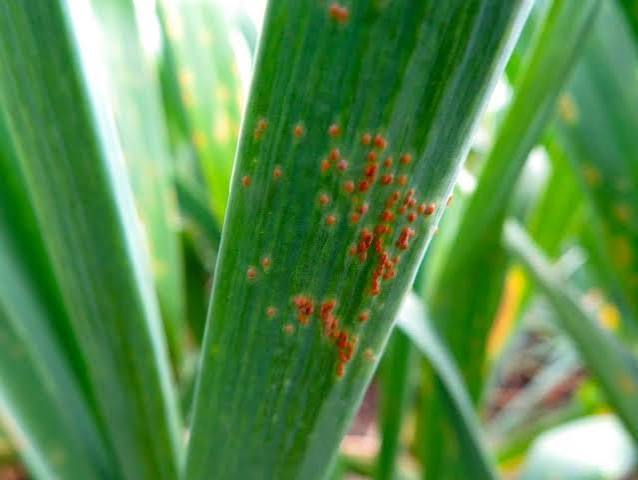
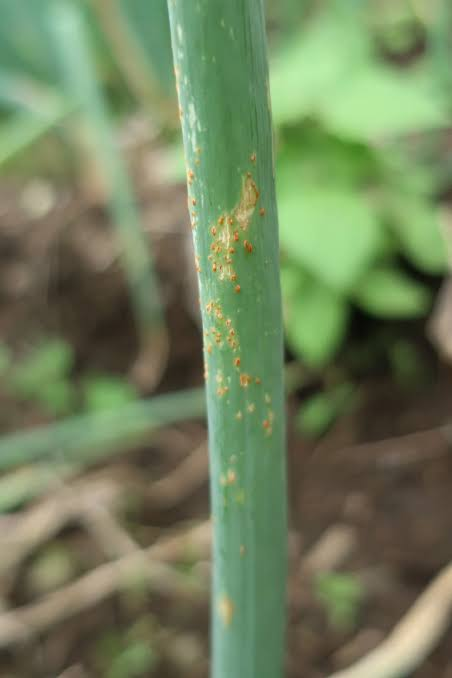
Onion rust is a fungal disease caused primarily by Puccinia allii. It attacks onions, garlic, leeks, and chives all members of the allium family. The fungus produces characteristic orange to reddish-brown pustules on leaves and stems, giving the crop its “rusty” appearance. For anyone serious about onion farming in Kenya, knowing the biology of this pathogen matters. The rust fungus survives between seasons on crop debris, volunteer allium plants, and wild allium relatives. When conditions turn favourable cool nights, warm days, high humidity, and leaf wetness the spores germinate and infect new growth within hours.Rust does not usually kill the plant outright. Instead, it weakens it. Infected leaves cannot photosynthesize efficiently, the bulbs fail to size up, and the foliage dies back prematurely. The result in onion farming in Kenya is smaller bulbs, lower yields, poor storage quality, and significant income loss.

Why Rust Is a Growing Problem in Onion Farming in Kenya:
Several factors explain why rust has become a major headache in onion farming in Kenya in recent years:
- Expanding allium acreage: More farmers growing onions, garlic, and leeks means more host plants for the fungus to survive on.
- Continuous cropping: Growing onions season after season on the same land builds up fungal spore loads in the soil and crop residue.
- Irrigation practices: Overhead irrigation, especially in the evening, keeps leaves wet overnight perfect conditions for rust infection.
- Climate variability: The cool, humid mornings common in Kenya’s highlands (Nyandarua, Nyeri, Meru, and the Rift Valley) favour rust outbreaks.
- Poor seed and seedling quality: Infected seedlings imported from unregulated nurseries can introduce rust into clean fields.
Regions known for intensive onion farming in Kenya such as Kajiado, Loitoktok, Narok, Baringo, and parts of Central Kenya report rust pressure almost every season, making disease management a core production skill rather than an afterthought.
How to Identify Onion Rust: Symptoms Every Farmer Must Know:
Early detection is the single most powerful weapon in onion farming in Kenya. Here is what to look for:
Early Symptoms:
- Small, pale green to yellow spots on the youngest leaves
- Tiny white or yellow flecks on the upper leaf surface
- Slight curling or distortion of new leaves
Advanced Symptoms:
- Bright orange, powdery pustules (uredinia) on both leaf surfaces
- Pustules merging into large rusty patches
- Leaves turning yellow, drying, and dying prematurely from the tips downward
- Severely infected plants stunted with underdeveloped bulbs
A simple field test: rub a suspected leaf between your fingers. If an orange, rust-coloured powder smears onto your skin, you are almost certainly looking at rust. Experienced practitioners of onion farming in Kenya check their fields at least twice a week during the vegetative stage, because early rust is far cheaper to manage than late rust.
What Conditions Favour Rust Outbreaks?
Understanding the disease triangle susceptible host, virulent pathogen, and favourable environment is fundamental to successful onion farming in Kenya. Rust thrives when:
- Temperatures range between 15°C and 22°C (typical of Kenyan highlands)
- Leaf wetness persists for 6+ hours from dew, rainfall, or overhead irrigation
- Humidity is high, especially in the early morning
- Plant density is excessive, reducing airflow within the canopy
- Excess nitrogen produces soft, lush, susceptible growth
- Fields have a history of allium crops, leaving inoculum in the residue
Pro tip from seasoned experts in onion farming in Kenya: the disease cycle can complete in as little as 7–10 days under ideal conditions, meaning one missed scouting round can allow rust to explode from a few spots to a full-blown epidemic.
Prevention: The First and Best Line of Defence:
In onion farming in Kenya, preventing rust is far more effective and far cheaper than curing it. Here is a layered prevention strategy:
1. Plant Resistant or Tolerant Varieties:
While no onion variety is completely immune to rust, some show useful tolerance. Red bulb varieties widely used in onion farming in Kenya, such as Red Pinoy, Red Creole, and Jambar F1, often show better field tolerance than highly susceptible types. Always source certified seed and seedlings from reputable suppliers like Onion Doctor.
2. Practice Strict Crop Rotation:
Avoid planting onions, garlic, leeks, or chives on the same field more than once every three to four years. Rotate with non-allium crops such as tomatoes, cabbage, beans, or maize. Rotation starves the rust fungus of its host and is a cornerstone of sustainable onion farming in Kenya.
3. Use Certified, Disease-Free Seedlings:
Buy seedlings only from registered nurseries like Onion Doctor. Inspect transplants before planting and reject any showing suspicious spots. A single infected bunch can compromise an entire field a lesson many newcomers to onion farming in Kenya learn the hard way.
4. Manage Irrigation Wisely:
Drip or furrow irrigation keeps foliage dry and dramatically reduces rust risk. If you must use overhead sprinklers, irrigate early in the morning so leaves dry quickly. Avoid late-evening irrigation at all costs.
5. Optimise Plant Spacing and Field Hygiene:
Proper spacing (typically 30 cm between rows and 8–10 cm within rows for bulb onions) improves airflow and speeds leaf drying. Remove and destroy crop residues after harvest, and eliminate volunteer onion and wild allium plants around field edges. Good hygiene is non-negotiable in professional onion farming in Kenya.
6. Balanced Fertilisation:
Excess nitrogen produces soft, succulent tissue that rust loves. Base your fertilizer program on a soil test, using adequate but not excessive nitrogen, plus sufficient potassium and phosphorus for sturdy, resilient growth.
Chemical Control: Fungicides That Work:
When prevention is not enough and in Kenyan conditions it often is not timely fungicide application becomes essential. Farmers engaged in onion farming in Kenya should note the following:
- Protectant fungicides such as mancozeb and chlorothalonil form a protective barrier on leaf surfaces and work best before infection or at the very first sign of disease.
- Systemic fungicides containing active ingredients like azoxystrobin, tebuconazole, or propiconazole are absorbed by the plant and can stop established infections.
- Alternate modes of action to prevent the fungus from developing resistance. Never rely on a single fungicide family all season.
Always follow label rates, observe pre-harvest intervals, and consult your local agricultural extension officer before spraying, because safe chemical use protects both consumers and the long-term reputation of onion farming in Kenya. Responsible chemical use is a hallmark of modern onion farming in Kenya.
The Bottom Line: Rust Is Manageable If You Act Early:
Rust does not have to destroy your season. The farmers who succeed in onion farming in Kenya share common habits: they scout early, rotate crops, source clean seed, manage irrigation, and respond quickly at the first sign of disease. Rust rewards procrastination and punishes it in equal measure. Onion farming in Kenya remains one of the most dependable horticultural income streams in the country, with strong domestic demand and growing export potential to the East African region. By mastering rust management, you protect not just one crop but your entire farming enterprise. Start this season with a plan: clean seed, a four-year rotation, weekly scouting, and a fungicide strategy ready before you need it. The most resilient producers in onion farming in Kenya treat disease management as a year-round discipline, not a crisis response. Your bulbs and your bank account will thank you.
Are you in need of in-depth knowledge on onion and garlic production? If yes, we are a call away. Contact us for: Onion seedlings, Garlic seedlings, Germinated garlic cloves, Farm planning services, Soil testing, training on onion and garlic growing, Drip irrigation installation and maintenance, Agronomic support, Onion and Garlic value pack and Farm management. For free consultation, placing orders or booking a visit with an agronomist, please contact us via Call or what’s app +254703982228, Email: info@oniondoctor.co.ke You can also check out our social media handles for daily updates on TikTok: https://www.tiktok.com/@oniondoctorke0706252490?_r=1&_t=ZS-96UPUyx6ESL Instagram:https://www.instagram.com/oniondoctorke?igsh=MW5sZzJ6c3BnZ3Z0dw==Facebook:https://www.facebook.com/share/1HouRgLCwS/Twitter:https://x.com/OnionDoctorKe?s=20