
Welcome to the fascinating journey of fertilization management in onion farming in Kenya! Fertilization is at the heart of achieving healthy, high-yield onion crops, and it plays a vital role in ensuring that farmers reap the full benefits of their hard work. With Kenya’s diverse soils and climates, proper nutrient management helps onions grow strong, resist diseases, and develop the firm bulbs that are in such high demand across markets. By understanding the balance of organic matter, nitrogen, phosphorus, and potassium, farmers can unlock the true potential of their land while maintaining sustainability. Fertilization management is not just about feeding the crop—it’s about nurturing the soil, supporting long-term productivity, and building a foundation for agribusiness success.
Are you in need of in-depth knowledge on onion and garlic production? If yes, we are a call away. Contact us for: Onion seedlings, Garlic seedlings, Germinated garlic cloves, Farm planning services, Soil testing, training on onion and garlic growing, Drip irrigation installation and maintenance, Agronomic support, Onion and Garlic value pack and Farm management. For free consultation, placing orders or booking a visit with an agronomist, please contact us via Call or what’s app +254703982228, Email: Info@oniondoctor.co.ke. You can also check out our social media handles for daily updates on TikTok: https://www.tiktok.com/@oniondoctorke?_t=ZM-8wmsTu0qumO&_r=1 Instagram: https://www.instagram.com/oniondoctorke?igsh=MTVoaHF3aWUydTJzaQ==Facebook:https://www.facebook.com/share/16SwgYn2dG/ Youtube:https://youtube.com/@oniondoctorke?si=u5Jnd-r0qU9UDYqL and Twitter: https://x.com/OnionDoctorKe?t=FR3JXlS_oN1vjjUgAtfyzg&s=09.
Key Takeaways
- Proper fertilization is key for growing large, strong onion bulbs
- Balanced fertilizers and nitrogen-rich solutions are ideal for onion growth
- Timing your fertilizer applications throughout the growing season is crucial
- Organic and chemical fertilizers both have benefits for onion cultivation
- Preparing the soil with nutrient-rich amendments can set onions up for success
Understanding Onion Growth Requirements
As a seasoned farmers, I’ve learned onions need different nutrients at different times. In the early stages, they do well in well-drained, rich soil with a pH of 6.0 to 7.0. Adding compost or aged manure to the soil helps a lot. It makes the soil more fertile and better at draining water, which is key for onion growth stages.
Growth Stages and Nutrient Needs
Onions need about 150-200 pounds of actual nitrogen per acre during the growing season. Phosphorus is best applied two inches to the side and two inches below the seed at planting. This helps seedlings grow strong early on.
As onions get bigger, they need more nitrogen after the bulbs start to form, especially after mid-July. Too much nitrogen can make onions mature late and not store well.
Optimal Soil Conditions for Onions
Onions need medium levels of potassium to grow well. Most soils have enough potassium. But, heavy rain can cause the soil to crust over, hurting onion growth if seeds or seedlings are disturbed before they emerge.
Using tools like disks, knives, duck feet, and furrow openers helps keep weeds away and promotes onion growth.
Best Fertilizer for Onion: Essential Types and NPK Ratios
Onions need a lot of nutrients to grow well. Knowing the best NPK ratios is key for a big harvest. Let’s look at the main fertilizers and what they offer for healthy onions.
Start with a 10-20-10 fertilizer when planting. It helps onions grow strong roots and grow fast early on. Later, switch to a 21-0-0 fertilizer every 2-3 weeks. This boosts leaf and stem growth.
When onions start to form bulbs, use a 10-10-10 or 12-12-12 fertilizer. These balanced formulas help bulbs grow big and strong. Keeping the NPK ratio right is vital for onions that are ready to store.
| Fertilizer Type | NPK Ratio | Growth Stage |
|---|---|---|
| Starter Fertilizer | 10-20-10 | Planting |
| Nitrogen-Rich Fertilizer | 21-0-0 | Early Growth (3 weeks after planting) |
| Balanced Fertilizer | 10-10-10 or 12-12-12 | Bulbing and Maturation |
Changing the fertilizer based on the onion’s growth is crucial. Giving the right nutrients at the right time helps onions grow big and flavorful.
Timing Your Fertilizer Applications
Getting the timing right for your onion fertilizer is key. It helps your onions grow well and produce more. You need to match the fertilizer schedule with the onion’s needs at each stage.
Early Season Fertilization
Begin with a high-nitrogen fertilizer when you plant or soon after. This gives the onion a strong start. Use ammonium sulfate (21-0-0) or calcium nitrate (15.5-0-0) based on your soil’s pH.
Apply these every 3 weeks. Adjust the amount based on your soil and the onion’s growth.
Mid-Season Nutrient Requirements
As onions grow, their needs change. In the slow and rapid growth phases, add more nitrogen. This helps the onions grow strong leaves and big, tasty bulbs.
Keep up a regular fertilizing routine. Stick with the same high-nitrogen fertilizers from the start.
When to Stop Fertilizing
Stop fertilizing when the onions start bulbing. This is when the ground cracks as the bulbs grow. Fertilizing too much after this can harm the bulb’s quality and storage.
By sticking to this fertilizing plan, you’ll give your onions the right nutrients at the right time. This will lead to a great onion harvest.
Chemical Fertilizers and Their Benefits
Chemical fertilizers are great for growing onions. They give plants the nutrients they need at each stage. There are many types, like balanced granular, nitrogen-rich, and slow-release, all good for onions.
Balanced Granular Fertilizers
Balanced granular fertilizers, like 10-10-10 or 12-12-12, are popular. They have nitrogen, phosphorus, and potassium. These nutrients help onions grow strong and produce big, tasty bulbs.
Nitrogen-Rich Solutions
Nitrogen is key for onion growth. It makes leaves green and bulbs big. Fertilizers like ammonium sulfate and calcium nitrate boost growth. They help onions grow well.
Fertilization Guidelines for Onion Cultivation – Critical Fertilization Stages
Below, we will mention some general guidelines regarding onion plant nutrition for commercial cultivation.
Onion is considered a heavy feeder and, compared to other vegetables, needs more nutrients to produce high yields. To decrease the risk of nutrient losses and to supply the plants with the amounts of nutrients in the most critical periods, it is best to split the total amount of nutrients into more than 1-2 doses. There is more than one fertilization program a farmer can apply depending on the type of fertilizers used and their combination (e.g., only base and side dressing, and fertigation + foliar nutrition.
In some cases, 40 kg per hectare of sulfur (S) is also applied. Fertilizer amounts may need to increase if the crop is grown from seed rather than sets or transplants.
Knowing that the nutrient demand peaks during the bulb growth stage (after the 7th leaf has emerged) is essential. As a result, the farmer should have applied the necessary amount (and type) of nutrients needed soon before that stage. Excessive and delayed N fertilization should be avoided since they can delay bulb formation and lead to softer bulbs (quality reduction and storability). Whichever fertilization scheme you follow, you are advised to stop applying when the plant’s neck starts feeling soft (around 4-5 weeks before harvest).
Fertilizer Application Methods – Fertigation Program for Onions
Nowadays, commercial growers use both liquids and granular fertilizers for onion cultivation. Many farmers start by applying 30-70 tonnes per hectare of well-rotted manure about 1 month before planting. Alternatively, if synthetic fertilizers are used, we can add 30-50% of the total N and 50% of P and K before planting. The rest of N will be added in the bulb initiation stage. Until the emergence of the 5th leaf, the farmer can apply ⅓ of N, ¼ of P, and the total amount of Ca, if needed. The rest of the amount is added at the onset of the bulb enlargement stage to cover the increased needs of the onion plants.
If fertigation is used, the farmers are advised to divide the total amount of fertilizers needed into four doses: one during plant establishment, one during vegetative growth, one during bulb initiation, and one during the bulb development stage. This program can be combined with pre-planting base soil fertilization. Microelements such as Zn, B, and Cu may also be required.
However, these are just some examples of fertilization patterns that no one should follow without doing their own research. Every field is different and has different needs. Checking the soil condition and pH is vital before applying any fertilization method. You have to consult your local licensed agronomist.
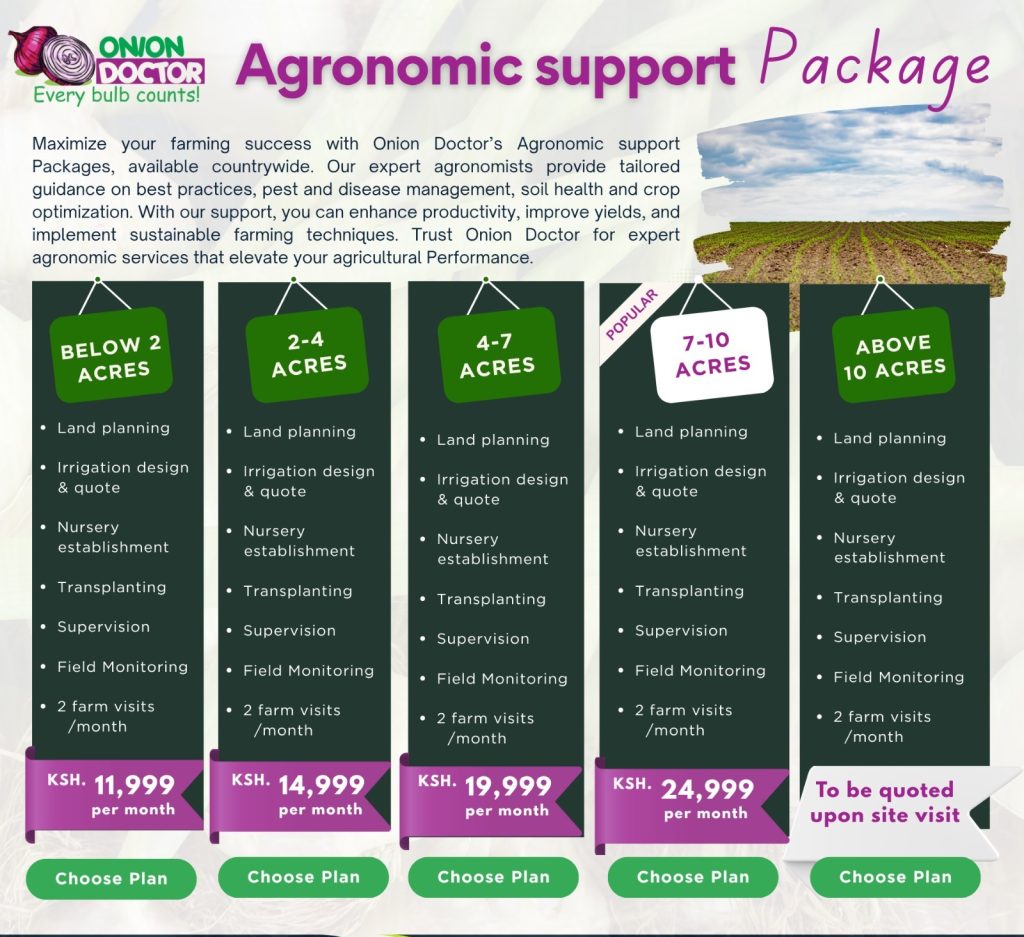
Onion farming in Kenya thrives on balanced fertilizer use—nitrogen for leaves, phosphorus for roots, potassium for bulbs. Proper nutrition boosts yield, shelf life, and market value. Yet success depends on marketing: cutting out middlemen, branding produce, and reaching buyers directly. The Onion Doctor guides farmers in both soil health and market strategy. Strong crops plus smart marketing equal strong incomes—the future is in growing smarter…