Whether you’re a smallholder farmer or managing a large-scale farm, understanding the best irrigation practices can make the difference between an average harvest and a bumper yield. In this blog, we’ll walk you through tried-and-tested methods that save water, reduce disease, and boost productivity.
Water Management in Onion Cultivation in Onion irrigation in Kenya
Water Quality Considerations
Salinity
Irrigation water with high salinity can negatively affect onion cultivation, causing water stress and reducing bulb growth. It is essential to monitor the electrical conductivity (EC) of the water and take corrective measures if necessary, such as mixing with lower salinity water or improving soil drainage.
Contamination
The use of water contaminated with pathogens, heavy metals, or chemicals can be harmful to the crop. It is important to ensure that the water used comes from clean and safe sources.
Drainage Management
A good drainage system is essential to avoid waterlogging, which can lead to bulb rot and disease proliferation. This includes:
- Field Design: Implement a design that allows for efficient natural drainage.
- Subsurface Drains: In soils with drainage problems, consider installing subsurface drains.
- Drainage System Maintenance: Ensure that drainage channels are clean and functioning properly, especially during rainy season.
Drip Irrigation System
A drip irrigation system is a method of watering plants by delivering water and directly to their roots through a network of tubes, pipes, and emitters, maximizing efficiency and minimizing water loss.
Reasons for Drip Irrigation in Onion Farming
- Being a water saving method it only enhances wetting patterns of onion root zones. This plays an important role in reducing rapid growing weeds that lowers yield.
- Drip irrigation enhances a balance in water supply to onions. Individual drops of water accumulate to a level required for efficient production. Water is available to onions every time, mostly, during critical growth levels.
- Drip irrigation moistens the soil and maintains the soil temperature, PH, and fertility. With drop-by-drop irrigation, the cooling effect, erosion, and humus removal does not occur.
- Labour requirements are low for drip irrigation. With water supply and distribution done by pipework, no casuals or manpower to operate the drip system.
- Drip irrigation increases onion yield as it provides optimal water and temperature needs that allows good growth environment.
- Drip irrigation rarely exposes onion bulbs and roots unlike other methods where water hits the ground at high pressure prone to erosion.
- With minimum water utilization, you can water a large farm with more onion plants with drip irrigation.
- Drip allows for fertilizers to be distributed easily and uniformly through drip. Fertilizers are mixed and introduced to plants through drip lines.
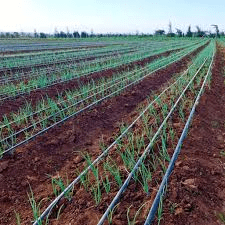
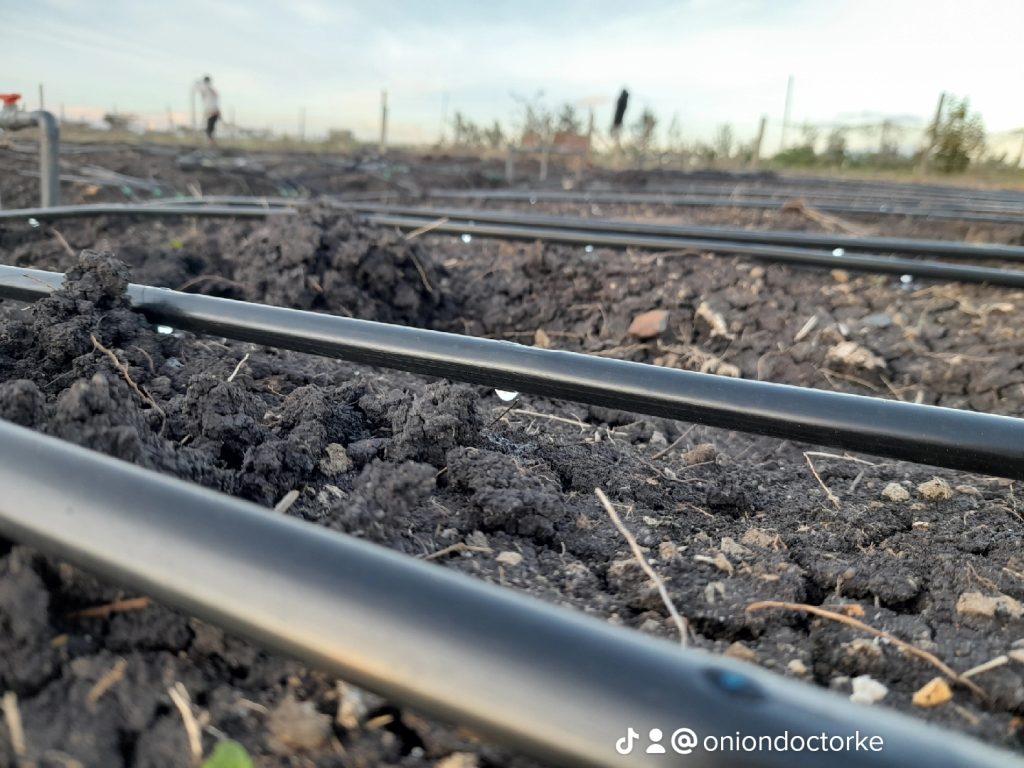
Components of Onion Drip Irrigation System
- HDPE or PVC pipes
- Drip emitter (15 cm Spacing)
- Water tank
- Ball Valves
- Connectors
- Tank connectors
- Filters
Furrow irrigation System
This irrigation method is commonly used for crops like corn, wheat, rice, and particularly in areas with relatively flat terrain. Furrow irrigation has been a reliable method of irrigation for centuries due to its simplicity and cost-effectiveness. It requires minimal infrastructure compared to other irrigation systems like drip or sprinkler irrigation.
Furrow irrigation is a surface irrigation technique that involves creating shallow trenches (furrows) between crop rows, which are then filled with water. These furrows are designed to direct the flow of water to the root zones of plants. As the water moves down the furrows, it infiltrates the soil, providing moisture to the plants’ roots.
Purpose of Furrow Irrigation
Furrow irrigation serves several purposes in modern agriculture. Its main goal is to supply water to crops, but it also offers other benefits that make it an attractive option for farmers in various regions. Here are the primary purposes of furrow irrigation:
1. Efficient Water Distribution
Furrow irrigation helps distribute water evenly across the crop field, ensuring that each plant receives adequate moisture. The system works by allowing water to flow between the rows of crops and seep into the soil. By maintaining proper flow rates and furrow depth, farmers can control how much water is supplied to each plant.
2. Minimizing Water Waste
Unlike flood irrigation, where water is distributed evenly over a large area, furrow irrigation ensures that water is directed specifically to the root zones of plants. This targeted water distribution reduces water wastage, making furrow irrigation a more efficient method compared to other surface irrigation techniques.
3. Suitable for a Variety of Crops
Furrow irrigation is versatile and can be used for a wide range of crops. It is particularly effective for row crops that require consistent watering, such as cereals, vegetables, and legumes. Additionally, furrow irrigation can be adapted to various soil types and climates, making it a popular choice in regions where other irrigation methods may not be feasible.
4. Cost-Effective
One of the major advantages of furrow irrigation is its low cost of implementation. Unlike drip or sprinkler systems, which require more complex infrastructure and equipment, furrow irrigation only needs simple trenching and water channels. This makes it a budget-friendly irrigation solution for farmers, especially those operating on smaller farms or in developing countries.
5. Improving Soil Structure
Furrow irrigation can also help improve soil structure. The regular supply of water encourages the growth of healthy plant roots, which can enhance soil aeration and reduce compaction. This can lead to improved soil health and better crop yields in the long term.
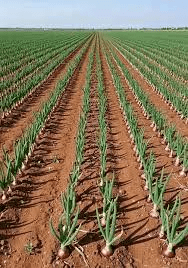
Basin Irrigation System
Advantages of Basin Irrigation System
Basin Irrigation system is mostly used by farmers with sufficient water and small scale farmers. This method of Irrigation is used by onion farming.
Principles of Basin Irrigation
Basin irrigation involves the creation of a level or gently sloping basin around the crops, which is then flooded with water. The water is allowed to infiltrate the soil, providing the necessary moisture for the crops to grow. The basin is typically surrounded by bunds or levees to prevent water from flowing out, and the water level is controlled to ensure that the crops receive the right amount of moisture.
The principle behind basin irrigation is to provide a uniform distribution of water to the crops, minimizing runoff and evaporation losses. By controlling the water level and flow rate, farmers can optimize water use and reduce waste.
Advantages and Limitations of Basin Irrigation in Onion Farming in Kenya.
Basin irrigation has several advantages, including:
- High water use efficiency: Basin irrigation can achieve high water use efficiency, particularly when combined with precision land leveling and water management systems.
- Reduced labor costs: Basin irrigation can reduce labor costs, as it eliminates the need for frequent irrigation and minimizes the risk of over-irrigation.
- Improved crop yields: By providing a uniform distribution of water, basin irrigation can improve crop yields and reduce the risk of water stress.
However, basin irrigation also has some limitations:
- High initial investment: Creating a basin irrigation system can require a significant initial investment, particularly if precision land leveling is required.
- Soil type limitations: Basin irrigation is not suitable for all soil types, particularly those with low infiltration rates or high salt content.
- Water management challenges: Basin irrigation requires careful water management to prevent over-irrigation and waterlogging.
Soil Management Techniques in Onion Farming In Kenya.
Understanding Onion Soil Requirements
Onions are one of the most widely cultivated crops in the world, and their growth is heavily dependent on the quality of the soil. To ensure a successful onion harvest, it’s essential to understand the specific soil requirements of onions. In this section, we’ll delve into the world of onion soil preparation, exploring the ideal soil conditions, common soil challenges, and practical tips for creating an onion-friendly soil environment.
Ideal Soil Conditions for Onions
Onions thrive in well-draining, fertile soils with a pH range of 6.0 to 7.0. They require a soil with good structure, adequate moisture, and a balanced nutrient profile. Here are some key characteristics of ideal onion soil:
- Well-draining soil: Onions don’t like wet feet, so the soil should drain excess water quickly to prevent waterlogged soil conditions.
- Fertile soil: Onions are heavy feeders and require a soil rich in nutrients, particularly nitrogen, phosphorus, and potassium.
- Neutral to slightly acidic pH: Onions prefer a slightly acidic to neutral soil pH, which helps to promote healthy growth and development.
- Good soil structure: Onions benefit from a soil with a mix of sand, silt, and clay, which provides good aeration, water-holding capacity, and root growth.
Common Soil Challenges for Onions
While onions are relatively easy to grow, they can be susceptible to various soil-related challenges. Here are some common soil issues that can affect onion growth:
- Soil compaction: Heavy foot traffic, machinery, or poor soil structure can lead to compacted soil, which restricts root growth and water penetration.
- Soil salinity: High salt levels in the soil can stunt onion growth, reduce yields, and affect flavor.
- Soil acidity: Soils with extremely low pH levels can lead to nutrient deficiencies, reduced growth, and increased susceptibility to diseases.
- Soil nutrient deficiencies: Lack of essential nutrients like nitrogen, phosphorus, or potassium can limit onion growth, reduce yields, and affect bulb quality.
Assessing Your Soil
Before planting onions, it’s essential to assess your soil’s condition, structure, and nutrient profile. Here are some steps to help you evaluate your soil:
- Soil testing: Conduct a soil test to determine the pH level, nutrient content, and texture of your soil.
- Visual inspection: Observe your soil’s structure, color, and texture to identify potential issues like compaction, erosion, or nutrient deficiencies.
- Soil sampling: Collect soil samples from different areas of your garden or field to get a representative picture of your soil’s condition.