Are you in need of in-depth knowledge on onion and garlic production? If yes, we are a call away. Contact us for: Onion seedlings, Garlic seedlings, Germinated garlic cloves, Farm planning services, Soil testing, training on onion and garlic growing, Drip irrigation installation and maintenance, Agronomic support, Onion and Garlic value pack and Farm management. For free consultation, placing orders or booking a visit with an agronomist, please contact us via Call or what’s app +254703982228, Email: Info@oniondoctor.co.ke. You can also check out our social media handles for daily updates on TikTok: https://www.tiktok.com/@oniondoctorke?_t=ZM-8wmsTu0qumO&_r=1 Instagram: https://www.instagram.com/oniondoctorke?igsh=MTVoaHF3aWUydTJzaQ==Facebook:https://www.facebook.com/share/16SwgYn2dG/ Youtube:https://youtube.com/@oniondoctorke?si=u5Jnd-r0qU9UDYqL and Twitter: https://x.com/OnionDoctorKe?t=FR3JXlS_oN1vjjUgAtfyzg&s=09.
Welcome to the Onion Doctor’s Corner – where we peel back the layers of life’s toughest challenges to uncover fresh, practical solutions. Just like an onion, every problem has layers — some may bring tears, others may surprise you with hidden sweetness. Here, we explore real struggles, share heartfelt stories, and offer remedies that heal from the inside out. Whether you’re facing personal hurdles, health concerns, or everyday dilemmas, the Onion Doctor is here to guide you toward clarity, resilience, and a brighter tomorrow.
Onion Diseases You May Encounter, and How to Deal with Them
All plants are prone to various health issues. Then again, what life form isn’t? Onions are quite hardy but can also suffer from many different diseases and pathogens. Below are the most common ones you might encounter and ways to counteract and heal them.
Damping-Off Disease
This is an issue you may encounter when you start your seedlings. It’s common when onions are planted outdoors too early and are exposed to cold, damp conditions. You can’t fix this once it sets in, but you can try to prevent it from happening.
Start your seeds in a soil-less starting medium, such as perlite or vermiculite and coconut coir. If you do start them in soil, make sure it’s a well-aerated potting mix. Avoid any soil that can be easily compacted, and only hydrate the seeds with warm water.
Additionally, you can try treating the seeds with a fungicide before planting. You can either look for commercial fungicides that contain metalaxyl or mefexonam, or slosh your seeds around in some diluted apple cider vinegar before planting.
Onion White Rot

This fungal disease can lurk in your soil for up to 20 years! It’s devastating to all allium crops and is responsible for crop failures worldwide. You can identify it by the fluffy white fungal growth around the bulb bases and stalks, as well as wilted, yellow leaves.
There’s no real treatment for this issue. Your only option is to destroy the crop, dig out the soil and treat it with hardcore fungicide and solarization, and avoid planting any alliums there for at least two decades. When you decide to try planting onions again, try to find rot-resistant varieties and soak the seeds in warm water before planting.
Fusarium Basal Plate Rot
This fungal disease manifests as yellowed, curled, necrotic leaves and brown, mushy bulbs. The fungus thrives in warm, damp conditions and doesn’t have a cure.
Prevention is best, once again. Make sure to plant in well-draining soil and rotate the area with non-allium crops for at least 5 years between onion plantings. You can also try planting fusarium-resistant varieties if you can find them.
Black Mold
Although black mold can grow on onions during the maturation process, it appears more often when the onions are stored. The symptoms hold true to its name: you’ll see black splotches around the onion’s neck, and it’ll spread into blackened/brownish, watery flesh in the bulb’s center. Avoid storing your bulbs in damp, warm conditions to prevent this stuff from appearing.
Downy Mildew

You’ve undoubtedly seen this one on several species before. It sort of looks like the fuzzy coating on one’s tongue after a week-long bender.
Powdery mildew is a fungal issue caused by the festive combination of wet foliage and cool temperatures. It also likes to hide in soil for long periods of time. You can treat both the soil and plants with organic fungicides and avoid the issue by watering at the soil level rather than overhead. Oh, and rotate crops regularly (noticing a trend?).
Purple Blotch

Pests Affecting Onion Farming in Kenya
This fungal issue is quite self-explanatory, as it causes purple blotches to appear on your onions’ stems. It’s common in areas that get a lot of humidity and high rainfall.
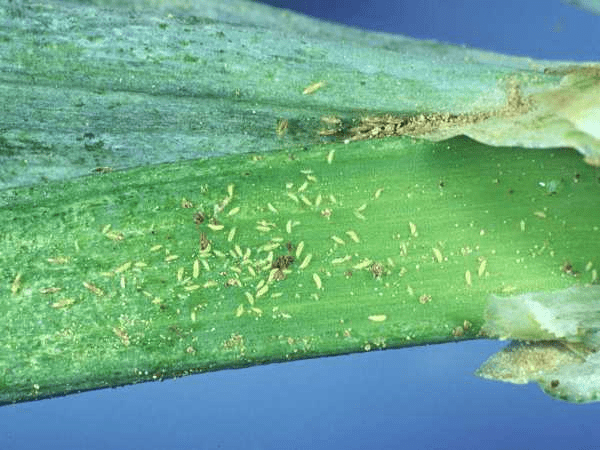
- Thrips: These tiny, winged insects suck the sap from onion leaves, causing them to become discolored and distorted. Thrips are also known to spread viruses, which can further damage the crop. Symptoms of thrips infestation include silver or white discoloration on the leaves, and the presence of small black or brown bugs on the foliage. Control methods include using sticky traps, planting companion crops, and releasing predators such as ladybugs or lacewings.
- Onion maggots: These small, white larvae feed on the roots of onions, causing the plants to wilt and die. Symptoms of onion maggot infestation include wilted plants, yellowing leaves, and the presence of small white larvae in the soil around the base of the plant. Control methods include crop rotation and using physical barriers like row covers.
- Onion aphids: These small, pear-shaped insects suck the sap from onion leaves, causing them to become distorted and discolored. Aphids also secrete a sticky residue called honeydew, which can attract ants and promote the growth of sooty mold. Symptoms of aphid infestation include distorted or curled leaves, yellowing, and the presence of small, soft-bodied insects on the foliage. Control methods include using insecticidal soap or neem oil and encouraging the presence of natural predators such as ladybugs and lacewings.
- Onion thrips: These small, winged insects feed on the leaves and bulbs of onions, causing them to become distorted and discolored. Symptoms of onion thrips infestation include silver or white discoloration on the leaves, and the presence of small, black or brown bugs on the foliage. Control methods include using sticky traps, planting companion crops, and releasing predators such as ladybugs or lacewings.
- Whitefly: These small, white, winged insects feed on the sap of onion leaves, causing them to become yellow and distorted. Symptoms of whitefly infestation include yellowing leaves, distorted growth, and the presence of small white flies on the foliage. Control methods include using insecticidal soap or neem oil and encouraging the presence of natural predators such as ladybugs and lacewings.
Control Method of Pest and Diseases in Onion Farming in Kenya
1. Use Integrated Pest Management (IPM)
Integrated Pest Management (IPM) is a comprehensive approach to controlling pests and diseases. It involves using a combination of different methods, such as biological control, cultural control, and chemical control. By using IPM, you can reduce the need for chemical pesticides, which can be harmful to the environment.
For example, one of the common pests that attack onions in Kenya is the thrips. To control thrips, you can use a combination of cultural and biological control methods, such as planting companion crops, using sticky traps, and releasing predators such as ladybugs or lacewings.
Another example is the onion maggot. To control onion maggots, you can use cultural control methods such as crop rotation, and using physical barriers like row covers.
2. Use Chemical Pesticides Only as a Last Resort
While chemical pesticides can be effective at controlling pests and diseases, they should be used as a last resort. This is because chemical pesticides can be harmful to the environment and can lead to the development of pesticide-resistant pests.
When using chemical pesticides, be sure to follow the label instructions carefully and only use the minimum amount necessary. Also, consider alternative methods such as neem oil or other bio-pesticides.
3. Practice Good Farming Practices
Good farming practices, such as proper irrigation, fertilization, and crop rotation, can also help to control pests and diseases. For example, by providing your onions with the right amount of water and nutrients, you can help to keep them healthy and strong, making them less susceptible to pests and diseases.
Additionally, crop rotation can help to reduce the build-up of pests and diseases in the soil by changing the type of crop grown in a specific area each year.
4. Monitor Your Crop Regularly
Finally, it is important to regularly monitor your crop for pests and diseases. This can be done by regularly inspecting your onions for symptoms of pests or diseases and taking action as soon as a problem is identified.
In conclusion, pests and diseases can be a major concern for onion farmers in Kenya. By properly identifying pests and diseases, using integrated pest management, using chemical pesticides only as a last resort, practicing good farming practices, and monitoring your crop regularly, you can effectively control pests and diseases and protect your onion crop. Remember to always consult with local experts for the best practices and recommendations for your specific region.
Soil Health Challenges
How can I improve soil fertility for my onion farm in Kenya?
I am always looking for ways to improve the fertility of my soil. After all, healthy soil means healthy plants, which in turn leads to better yields and more profitable harvests. In this article, I will share some tips and techniques that I have found to be effective in improving soil fertility for my onion farm.
One of the most important things to keep in mind when it comes to soil fertility is the importance of maintaining a good balance of nutrients. This includes not only the major nutrients such as nitrogen, phosphorus, and potassium but also the secondary and micronutrients that are essential for plant growth.
Compost
One way to achieve this balance is through the use of compost. Compost is made by breaking down organic matter, such as leaves and grass clippings, into a rich, nutrient-dense material that can be added to the soil. Composting is easy to do and can be done on a small scale using simple methods like pit or trench composting.
Cover Crops
Another way to improve soil fertility is through the use of cover crops. Cover crops are plants that are grown specifically to improve soil health. They can be used to add organic matter to the soil, to fix nitrogen, suppress weeds, and reduce erosion. Cover crops can be grown in between rows of onions, and then plowed under to add organic matter and nutrients back into the soil.
Crop Rotation
Another technique that I have found to be effective is crop rotation. Crop rotation helps to break pest and disease cycles, as well as to improve soil fertility by rotating different crops through different fields. This can be done by rotating onions with other crops such as maize, beans, or peas. By rotating different crops, the soil is replenished with different nutrients and the soil is less likely to become depleted.
Organic Fertilizers
Another way to improve soil fertility is through the use of organic fertilizers. Organic fertilizers are made from natural materials such as bone meal, blood meal, and fish emulsion. They are a great alternative to synthetic fertilizers and can be used to provide plants with the nutrients they need to grow healthy and strong.
Beneficial Microorganisms
Finally, another way to improve soil fertility is through the use of beneficial microorganisms. Beneficial microorganisms are microorganisms that help to improve soil fertility by breaking down organic matter and making nutrients available to plants. These microorganisms can be added to the soil through the use of compost teas or by using products such as mycorrhizal fungi.
Improving soil fertility is crucial for any onion farm. By using techniques such as composting, cover crops, crop rotation, organic fertilizers, and beneficial microorganisms, farmers can improve soil fertility and increase yields. These methods can be used in a sustainable and eco-friendly way, making them a great choice for farmers looking to improve their soil fertility