
At Onion Doctor Limited, we know that irrigation is the single biggest factor determining your onion farm’s profitability. With Kenya’s increasingly unpredictable rainfall patterns and rising water costs, choosing between basin irrigation and drip irrigation can mean the difference between a thriving harvest and a failed crop. Whether you’re farming in Kajiado, Nakuru, Makueni, or Bomet, this comprehensive guide brought to you by Onion Doctor Limited breaks down every cost , analyzes soil compatibility, and helps you make the irrigation decision that maximizes your onion yield and protects your budget.
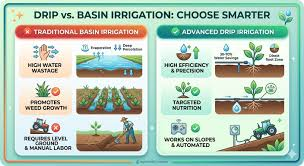
Basin irrigation for Onion Farming:
Basin irrigation is the traditional method where your onion field is divided into small, level plots surrounded by ridges or bunds. Water is flooded into these basins and allowed to infiltrate the soil naturally.
Advantages of basin irrigation:
- Cost-Effective Irrigation Method: Easy and affordable to set up because it does not require expensive or complicated equipment.
- Excellent Weed Suppression: Helps reduce weed growth around the plant base, minimizing competition for nutrients and water.
- Easy to Manage: Farmers can easily control water flow into each basin without advanced technical skills.
- Can Improve Soil Moisture Retention :Basins hold water around the crop, reducing rapid moisture loss during hot weather
Disadvantages of basin irrigation:
- High Water Loss :Significant amounts of water can be lost through evaporation and seepage, making it less water-efficient.
- Risk of Waterlogging: Excess water around onion roots may cause bulb rot, root diseases, and poor crop growth.
- Uneven Water Distribution :Some basins may receive too much water while others remain dry, leading to uneven onion bulb sizes.
- Encourages Soil-Borne Diseases: Wet soil conditions can promote diseases such as damping-off, pink root, and basal rot.
- Labor Intensive: Farmers need time and labor to construct, maintain, and manage the basins.
- Lower Water Efficiency Compared to Drip Irrigation: Basin irrigation uses more water than modern systems like drip irrigation, which deliver water directly to the onion root zone.
Drip irrigation in Onion farming:
Drip irrigation is a modern pressurized system that delivers water directly to your onion root zone through tubes, pipes, and emitters. This precision method minimizes water waste by targeting only where onion roots are actively growing.
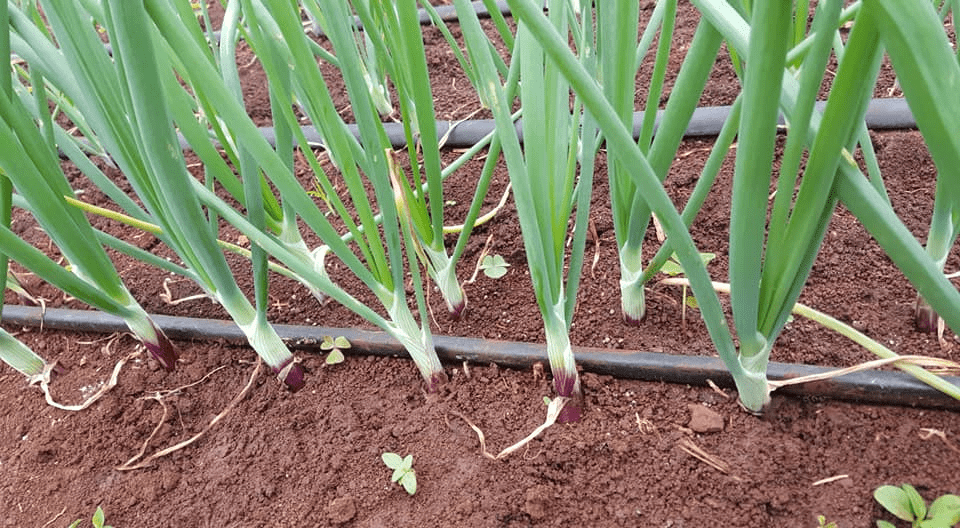
Advantages of Drip irrigation:
- Saves water by delivering moisture directly to onion roots.
- Improves bulb size, quality, and overall yield.
- Reduces weed growth and fungal diseases.
- Increases fertilizer efficiency through fertigation.
- Saves labor and boosts farm profitability.
Disadvantages of Drip irrigation:
- High initial installation and setup costs.
- Drip emitters can clog easily without clean water.
- Requires regular maintenance and technical knowledge.
- Pipes can be damaged by rodents or field activities.
- Depends on reliable water pressure and power supply.
Cost Comparison: Basin vs. Drip Irrigation for Onion Farming in Kenya (2026):
| Farm Size | Basin Irrigation (KES) | Drip Irrigation – 2 Lines/Bed (KES) | Drip Irrigation – 3 Lines/Bed (KES) |
| 1/8 Acre | KES 5,000 | KES 28,000 | KES 38,000 |
| 1/4 Acre | KES 10,000 | KES 40,000 | KES 55,000 |
| 1/2 Acre | KES 20,000 | KES 65,000 | KES 85,000 |
| 1 Acre | KES 35,000 | KES 130,000 | KES 165,000 |
Key Insight from Onion Doctor Limited: Basin irrigation has significantly lower upfront costs because it requires minimal equipment primarily land leveling and basic channel construction. Drip irrigation demands investment in pipes, emitters, filters, pumps, and pressure regulators.
Long-Term Operational Costs (Per Acre, Per Season in KES):
While basin irrigation is cheaper to install, drip irrigation often delivers superior long-term value for onion farmers:
| Cost Category | Basin Irrigation (KES) | Drip Irrigation (KES) | Savings with Drip |
| Water Usage | KES 45,000 | KES 18,000 | KES 27,000 (60% less) |
| Labor Costs | KES 60,000 | KES 20,000 | KES 40,000 (67%less) |
| Fertilizer Costs | KES 80,000 | KES 48,000 | KES 32,000 (40% less) |
| Maintenance | KES 15,000 | KES 25,000 | -KES 10,000 |
| Energy Costs | KES 25,000 | KES 35,000 | -KES 10,000 |
| TOTAL ANNUAL | KES 225,000 | KES 146,000 | KES 79,000 saved |
Return on Investment and Payback Period:
| Metric | Basin Irrigation | Drip Irrigation |
| Yield per Acre | 8-12 tonnes | 15-20 tonnes |
| Market Price (KES/kg) | KES 60 | KES 60 |
| Revenue per Acre | KES 480,000 – 720,000 | KES 900,000 – 1,200,000 |
| Net Profit (after costs) | KES 255,000 – 495,000 | KES 754,000 – 1,054,000 |
| Payback Period for Drip | N/A | 1-2 seasons |
The Onion Doctor Limited Verdict: If you’re growing onions commercially, the higher yield from drip irrigation (up to 67% more bulbs per acre) combined with lower operating costs makes it the clear winner for long-term profitability.
Are you in need of in-depth knowledge on onion and garlic production? If yes, we are a call away. Contact us for: Onion seedlings, Garlic seedlings, Germinated garlic cloves, Farm planning services, Soil testing, training on onion and garlic growing, Drip irrigation installation and maintenance, Agronomic support, Onion and Garlic value pack and Farm management. For free consultation, placing orders or booking a visit with an agronomist, please contact us via Call or what’s app +254703982228, Email: info@oniondoctor.co.ke You can also check out our social media handles for daily updates on TikTok: https://www.tiktok.com/@oniondoctorke0706252490?_r=1&_t=ZS-96UPUyx6ESL Instagram:https://www.instagram.com/oniondoctorke?igsh=MW5sZzJ6c3BnZ3Z0dw==Facebook:https://www.facebook.com/share/1HouRgLCwS/Twitter:https://x.com/OnionDoctorKe?s=20