
Onions are shallow-rooted, water-sensitive crops. Too little water? Small bulbs and stunted growth. Too much? Bulb rot, fungal diseases, and total crop loss. The irrigation method you choose doesn’t just affect water bills it determines your yield, bulb quality, disease pressure, labour costs, and ultimately, your profit per acre. In this definitive 2026 guide, we break down drip irrigation vs overhead (sprinkler) irrigation for onion farming in Kenya with real costs, yield data and expert recommendations from Onion Doctor.
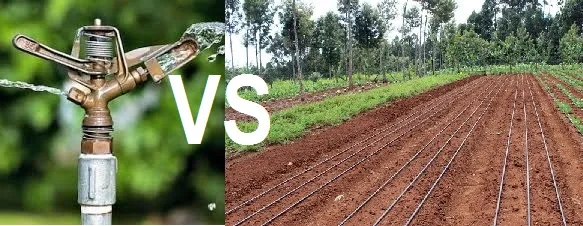
Why Irrigation is the Make-or-Break Factor for Onion Farming in Kenya {#why-irrigation-matters}:
Onions have a shallow, fibrous root system that rarely penetrates beyond 15–20 cm deep. This means they cannot access deep soil moisture like maize or beans. Without consistent, controlled irrigation:
- Bulbs fail to size up properly
- Yield drops by 30–50%
- Foliage diseases like downy mildew and purple blotch explode
- Cracking and splitting reduce market value
Kenya’s rainfall is increasingly erratic. The long rains (March–May) are shortening, and dry spells during critical bulbing stages are becoming common. Farmers who rely solely on rain-fed production gamble with their entire investment.
Understanding Drip Irrigation for Onions:
Drip irrigation is a pressurized micro-irrigation system that delivers water slowly and directly to each plant’s root zone through a network of pipes, tubes, and emitters. For onions, this precision is game-changing.
How Drip Irrigation Works for Onions:
Water flows from a source (tank, river, or borehole) through:
- Mainline & sub-main pipes (HDPE or PVC)
- Filtration system (screen or disc filter)
- Control valves (to partition the farm)
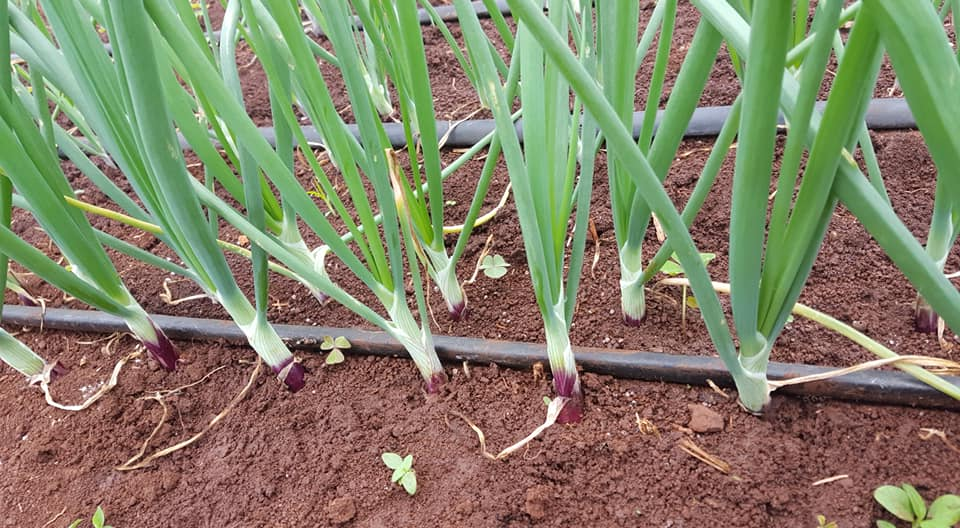
- Drip lines/tape laid along raised beds
For onions, the standard configuration is:
- 3 or 4 drip lines per bed (1-meter wide raised beds)
- 15–20 cm emitter spacing
Key Advantages of Drip Irrigation for Onions:
| Advantage | Impact on Your Farm |
|---|---|
| Water Savings | Uses 40–60% less water than overhead/sprinkler methods |
| Higher Yields | 15–20 tonnes/acre vs 8–12 tonnes with basin/overhead |
| Disease Reduction | Keeps foliage dry, drastically reducing downy mildew & fungal infections |
| Fertigation | Apply water-soluble fertilizers directly through the system for precision feeding |
| Weed Control | Water targets only root zones, leaving inter-row spaces dry |
| Labour Savings | 67% less labour compared to basin irrigation |
| Uniform Bulb Size | Consistent moisture = consistent, marketable bulbs |
Disadvantages of Drip Irrigation:
- High initial cost (KES 170,000–200,000 per acre)
- Emitter clogging if water isn’t filtered properly
- Rodent damage to drip lines
- Requires technical knowledge for setup and maintenance
- Dependent on reliable water pressure/power
Understanding Overhead (Sprinkler) Irrigation for Onions:
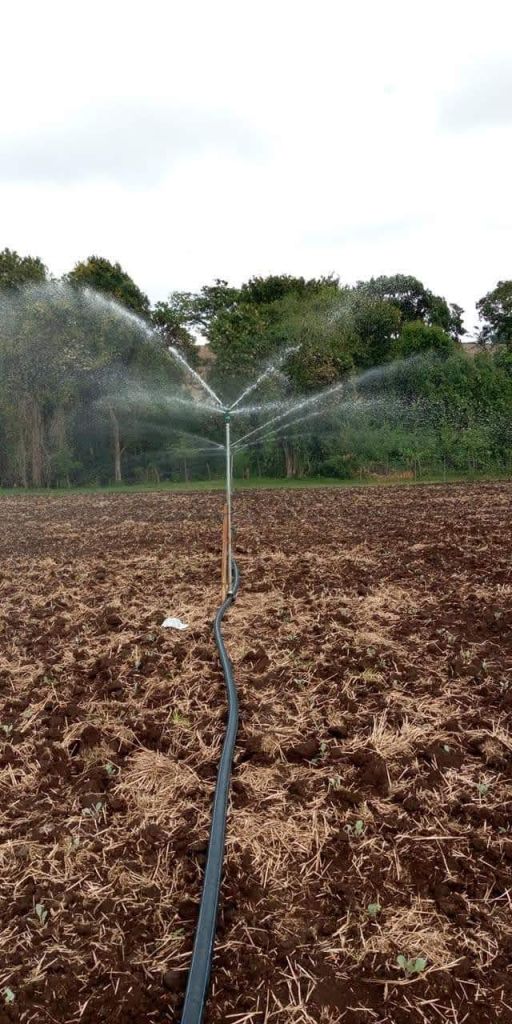
Overhead irrigation mimics rainfall, distributing water through pressurized spray heads, impact sprinklers, or rain guns across the entire field surface.
Types of Overhead Systems Used in Kenya:
| System Type | Cost per Acre | Best For |
|---|---|---|
| Impact Sprinklers | KES 50,000–65,000 | Medium-sized plots, uneven terrain |
| Rain Guns | KES 65,000/acre | Large open fields |
| Micro-Sprinklers | KES 85,000/acre | Orchards, high-value crops |
| Pivot Systems | KES 500,000+ | Very large commercial farms |
When Overhead Irrigation Makes Sense:
Overhead irrigation isn’t “bad” it’s just less ideal for onions. It works better for:
- Large pasture or fodder crops
- Tea estates (where canopy wetting is beneficial)
- Cereals like maize at scale
- Farms with abundant, cheap water
- Farmers with very low capital who need any irrigation vs. none
The Critical Problem with Overhead Irrigation for Onions:
When water sits on onion leaves especially in Kenya’s warm, humid climates like Kisumu or coastal regions it creates the perfect environment for:
- Downy mildew (the #1 onion killer)
- Purple blotch
- Botrytis leaf blight
- Bacterial soft rot
One severe disease outbreak can wipe out your entire crop and investment. For a high-value, disease-prone crop like onions, this risk is simply too high.
Head-to-Head Comparison: Costs, Yields & Return On Investment:
This is where the rubber meets the road. Let’s compare real 2026 Kenyan farm data.
Initial Installation Costs (Per Acre):
| Farm Size | Overhead/Sprinkler | Drip (2 Lines/Bed) | Drip (3 Lines/Bed — Recommended for Onions) |
|---|---|---|---|
| 1/8 acre | KES 8,000–12,000 | KES 22,000–28,000 | KES 38,000 |
| 1/4 acre | KES 15,000–20,000 | KES 42,000–55,000 | KES 55,000 |
| 1/2 acre | KES 30,000–35,000 | KES 65,000–85,000 | KES 85,000 |
| 1 acre | KES 50,000–65,000 | KES 130,000–140,000 | KES 170,000–200,000 |
Annual Operating Costs (Per Acre, Per Season):
| Cost Category | Overhead/Basin | Drip Irrigation | Savings with Drip |
|---|---|---|---|
| Water Usage | KES 45,000 | KES 18,000 | KES 27,000 (60%) |
| Labour | KES 60,000 | KES 20,000 | KES 40,000 (67%) |
| Fertilizer | KES 80,000 | KES 48,000 | KES 32,000 (40%) |
| Maintenance | KES 15,000 | KES 25,000 | -KES 10,000 |
| Energy/Fuel | KES 25,000 | KES 35,000 | -KES 10,000 |
| TOTAL | KES 225,000 | KES 146,000 | KES 79,000 saved |
Yield & Revenue Comparison (Per Acre):
| Metric | Overhead/Basin | Drip Irrigation |
|---|---|---|
| Yield | 8–12 tonnes | 15–20 tonnes |
| Market Price | KES 60/kg | KES 60/kg |
| Gross Revenue | KES 480,000–720,000 | KES 900,000–1,200,000 |
| Production Cost | KES 225,000 | KES 146,000 |
| Net Profit | KES 255,000–495,000 | KES 754,000–1,054,000 |
| Return on Investment | ~110–220% | ~400–700% |
Disease & Pest Management: Why Drip Wins:
Onion leaves are magnets for fungal pathogens when wet. Here’s the disease risk comparison:
| Disease | Cause | Risk with Overhead | Risk with Drip |
|---|---|---|---|
| Downy Mildew | Wet foliage + humidity | EXTREME | Minimal |
| Purple Blotch | Prolonged leaf wetness | HIGH | Low |
| Botrytis | Moist canopy | HIGH | Low |
| Bacterial Soft Rot | Waterlogged soil | Moderate | Low |
| Pink Root | Saturated soil | Moderate | Low |
With drip irrigation, water never touches the leaves. The foliage stays dry. Fungal spores can’t germinate without moisture. This alone can save you KES 20,000–30,000 per acre in fungicide costs and lost yield.
Final Verdict: Which System Should You Choose?
Choose Drip Irrigation If:
- You’re growing onions commercially for profit
- Water is scarce, expensive, or pumped from depth
- You want to minimize fungal diseases
- You plan to use fertigation
- You’re farming 1/8 acre to 10 acres
Choose Overhead Irrigation If:
- You have abundant, cheap water
- You’re farming very large acreage (10+ acres) with multiple crops
- Your primary crops are pasture, cereals, or tea
- You absolutely cannot afford drip initial costs
- You accept higher disease risk and lower onion yields
Are you in need of in-depth knowledge on onion and garlic production? If yes, we are a call away. Contact us for: Onion seedlings, Garlic seedlings, Germinated garlic cloves, Farm planning services, Soil testing, training on onion and garlic growing, Drip irrigation installation and maintenance, Agronomic support, Onion and Garlic value pack and Farm management. For free consultation, placing orders or booking a visit with an agronomist, please contact us via Call or what’s app +254703982228, Email: info@oniondoctor.co.ke You can also check out our social media handles for daily updates on TikTok: https://www.tiktok.com/@oniondoctorke0706252490?_r=1&_t=ZS-96UPUyx6ESL Instagram:https://www.instagram.com/oniondoctorke?igsh=MW5sZzJ6c3BnZ3Z0dw==Facebook:https://www.facebook.com/share/1HouRgLCwS/Twitter:https://x.com/OnionDoctorKe?s=20