
Every successful onion harvest begins with one critical decision: seeds or seedlings? For anyone serious about onion farming in Kenya, this choice isn’t just about convenience it directly impacts your yield, timeline, labor costs, and ultimately, your profit per acre. Onions are biennial crops grown as annuals, and how you start them determines everything that follows. Whether you’re a smallholder in Nyeri or a commercial grower in Naivasha, mastering the seed-versus-seedling debate is essential for profitable onion farming in Kenya. In this guide, we break down the science, economics, and practical realities so you can make the smartest choice for your farm.

Understanding Onion Seeds: The Direct Seeding Approach:
What Are Onion Seeds?
Onion seeds are tiny, black, tear-shaped propagules that germinate into onion plants. Direct seeding means sowing these seeds straight into prepared field beds or nursery trays. Onion farming in Kenya relies heavily on certified seed varieties like Red Coach, African Red, Malbec F1, and Neptune F1

Advantages of Using Seeds:
- 1. Lower Initial Investment Seeds are significantly cheaper than purchasing ready seedlings. For budget-conscious farmers, onion farming in Kenya starts more affordably with direct seeding. A 100g packet of certified hybrid seed costs a fraction of what you’d pay for the equivalent number of seedlings.
- 2. Stronger Root Development Seeds germinate and establish directly in their final growing environment, developing deep, natural root systems without transplant shock. This resilience matters enormously in onion farming in Kenya, where erratic rainfall can stress shallow-rooted crops.
- 3. Higher Plant Density Potential When managed correctly with proper thinning, direct seeding allows you to achieve optimal plant populations. In onion farming in Kenya, this can translate to 150,000–180,000 plants per acre when spacing is controlled
- 4. Access to Premium Varieties Certified seed gives you direct access to the best genetics. From drought-tolerant Red Creole to high-yielding Red coach F1 (yielding up to 15 tons per acre), onion farming in Kenya thrives on variety selection matched to your agro-ecological zone.
Disadvantages of Using Seeds:
- 1. Slower Establishment Germination takes 10–14 days, and early growth is vulnerable. In onion farming in Kenya, this extended period exposes crops to weed competition and pests during the most fragile stage.
- 2. Higher Labor for Thinning Direct-seeded fields require meticulous thinning to achieve uniform spacing. Many newcomers to onion farming in Kenya underestimate this labor demand, leading to overcrowding and small, unmarketable bulbs.
- 3. Uneven Germination Soil crusting, inconsistent moisture, and poor seedbed preparation cause patchy stands. Onion farming in Kenya often suffers from variable bulb sizes when germination is uneven, reducing pack-out rates at market.
- 4. Greater Weather Risk Seeds are highly susceptible to drought and flooding during germination. In rain-fed onion farming in Kenya, a single dry spell at the wrong moment can destroy an entire seedbed.
Understanding Onion Seedlings: The Transplant Method:
What Are Onion Seedlings?
Onion seedlings are young plants raised in a controlled nursery for 6–8 weeks before being transplanted to the main field. They arrive at your farm pencil-thick, 10–15 cm tall, with 3–4 true leaves
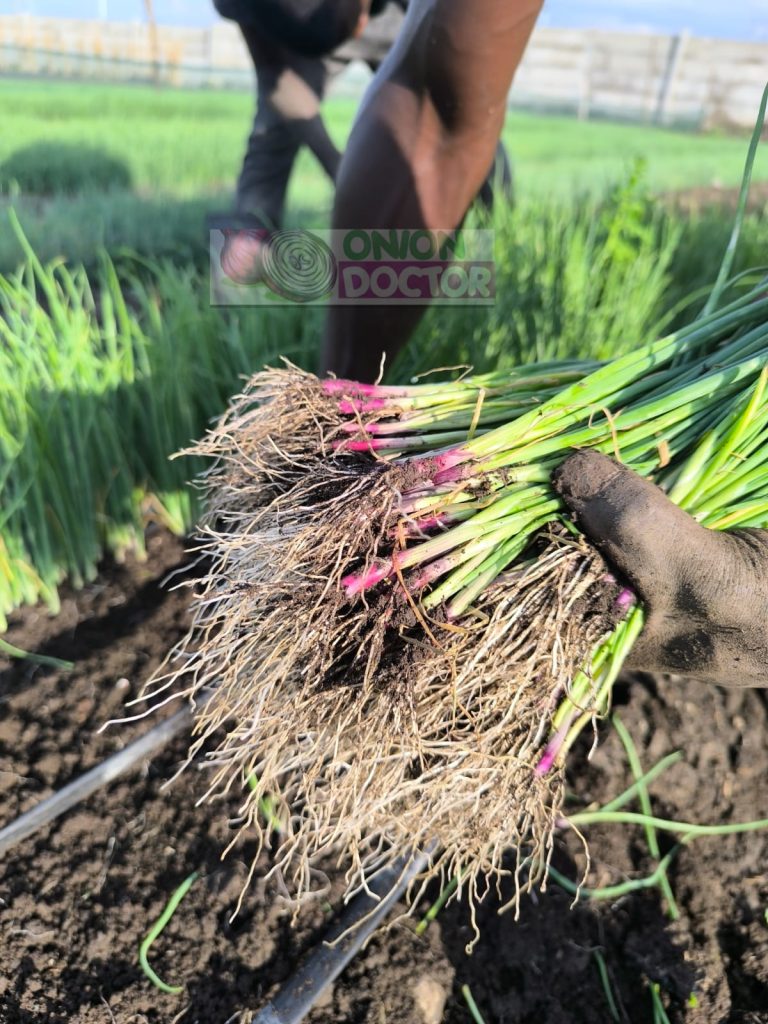
Advantages of Using Seedlings:
- 1. Faster Crop Cycle: Transplanting gives your crop a 4–6 week head start. For onion farming in Kenya, this acceleration is a game-changer harvest moves from 120–150 days down to 90–120 days after transplanting, allowing you to hit premium market windows
- 2. Uniform Stands and Bulb Sizes: Nursery-raised seedlings produce remarkably consistent crops. In onion farming in Kenya, where buyers pay premiums for uniform grading, this consistency directly boosts your price per kilogram.
- 3. Better Pest and Weed Management: The nursery stage isolates young plants from field pests and weeds. Onion farming in Kenya struggles heavily with thrips, cutworms, and leaf miners transplants bypass the most vulnerable early window.
- 4. Precision Market Timing Because you control the nursery start date, you can time harvests to coincide with high-price periods. Strategic onion farming in Kenya targets the January–February import gap when Tanzanian supply drops and local prices spike to KSh 60–80 per kilogram.
- 5. Higher Survival Rates Quality seedlings establish quickly with minimal mortality. For commercial onion farming in Kenya, this predictability makes financial planning and buyer commitments far easier.
Disadvantages of Using Seedlings:
- 1. Higher Upfront Costs Whether you raise them yourself or buy from certified suppliers, seedlings cost more than raw seed. However, onion farming in Kenya data shows that the 20–30% yield increase from transplants often more than covers this premium.
- . Transplant Shock Poor handling during uprooting and planting causes wilting and stunted recovery. In onion farming in Kenya, this risk is minimized by watering nurseries before uprooting, trimming roots lightly, and cutting leaves to 8–10 cm
- 3. Nursery Management Expertise Raising your own seedlings demands knowledge of seedbed preparation, disease control, and hardening-off. Beginners in onion farming in Kenya sometimes fail at this stage, producing weak transplants.
- 4. Disease Introduction Risk Buying seedlings from uncertified sources can introduce soil-borne diseases like Fusarium basal rot and pink root into your fields. Reputable onion farming in Kenya operations always verify seedling certification.
Head-to-Head Comparison: Seeds vs Seedlings:
| Factor | Onion Seeds | Onion Seedlings |
|---|---|---|
| Initial Cost | Low (KSh 40,000–52,000/acre) | Higher (KSh 100,000–150,000/acre) |
| Time to Harvest | 120–150 days | 90–120 days after transplant |
| Labor Intensity | High (thinning, weeding) | Moderate (transplanting) |
| Yield Potential | 5–8 tons/acre | 10–15+ tons/acre |
| Uniformity | Variable | High |
| Weather Resilience | Lower | Higher |
| Best For | Large-scale, mechanized farms | Intensive, market-driven operations |
This comparison reveals why onion farming in Kenya is increasingly shifting toward seedlings for commercial production, while seeds remain viable for experienced large-scale growers with mechanized thinning capacity.
Economic Analysis: Which Makes More Money?
Let’s talk numbers because profit is what matters.
Scenario A: Direct Seeding:
- Seed cost: KSh 40,000
- Labor (thinning/extra weeding): KSh 15,000
- Yield: 8 tons/acre
- Price: KSh 50/kg average
- Gross Revenue: KSH 400,00
- Net Revenue: KSH 250,000
Scenario B: Seedling Transplants:
- Seedling cost: KSh 150,000
- Labor (transplanting): KSh 10,000
- Yield: 15 tons/acre
- Price: KSh 55/kg (premium for uniformity)
- Gross Revenue: KSh 825,000
- Net Margin: ~KSh 500,000
The math is clear: despite higher upfront costs, onion farming in Kenya with seedlings generates substantially more profit per acre. The combination of higher yields, better quality, and market timing advantages creates a compelling return on investment.
Best Practices for Maximum Yields:
Regardless of your propagation choice, these principles drive success in onion farming in Kenya:
- 1. Soil Preparation: Test your soil and aim for pH 6.0–7.0. Well-drained sandy loam is non-negotiable. Onion farming in Kenya fails repeatedly in waterlogged clay soils.
- 2. Certified Inputs Only: Use certified seed or seedlings from Onion Doctor. Counterfeit inputs are the silent killer of onion farming in Kenya.
- 3. Precision Spacing: Maintain 10 cm between plants and 30 cm between rows. Proper spacing increases bulb size by over 20% compared to overcrowding.
- 4. Irrigation Discipline: Drip irrigation is the gold standard. Onion farming in Kenya under drip uses water efficiently, reduces weeds, and prevents the fungal diseases caused by overhead sprinklers.
- 5. Fertilizer Strategy : Apply phosphorus-rich basal fertilizer (like DAP) at planting for root establishment. Side-dress with nitrogen during vegetative growth, then switch to potassium-heavy feeds during bulb formation. Onion farming in Kenya that skips this staged nutrition ends up with small, soft bulbs.
- 6. Thrips Management :Scout weekly. Thrips alone can slash yields by 30–50% in unmanaged onion farming in Kenya.
- 7. Timely Harvest and Curing: Harvest when 70–80% of tops have fallen over. Cure under shade for 2–3 weeks. Proper curing extends storage from weeks to months a critical profit protector in onion farming in Kenya.
Common Mistakes to Avoid:
- 1. Planting in Poorly Drained Soils: This is the #1 cause of failure. Onion farming in Kenya demands raised beds where drainage is suspect.
- 2. Using Uncertified Seed :The temptation to save KSh 1,000 on seed often costs KSh 100,000 in lost yield. Onion farming in Kenya rewards those who invest in verified genetics.
- 3. Excessive Late-Season Nitrogen: This causes soft bulbs that rot in storage. Onion farming in Kenya requires discipline in switching to potassium during bulb enlargement.
- 4. Ignoring Post-Harvest Curing: Rushing bulbs to market without curing destroys shelf life. Patient onion farming in Kenya earns higher prices for well-cured, long-storing produce.
- 5. Poor Market Timing Harvesting when Tanzanian imports flood the market crashes prices. Calendar-aware onion farming in Kenya plans backward from premium windows.
The Verdict: Which Is Better?
After analyzing agronomy, economics, risk, and market dynamics, onion seedlings are the better choice for most Kenyan farmers especially those operating under 10 acres with market-driven production goals.The 20–30% yield boost, faster harvest cycles, uniform quality, and reduced early-stage risk make seedlings the engine of modern, profitable onion farming in Kenya. The higher upfront cost pays for itself many times over in increased revenue and reduced crop failure risk.However, direct seeding retains a place for:
- Very large mechanized operations where transplanting labor is prohibitive
- Farmers with excellent seedbed preparation skills and reliable rainfall
- Growers with access to precision seeders and automated thinning equipment
For the ambitious smallholder, the emerging commercial farmer, or the diaspora investor entering onion farming in Kenya, seedlings represent the lower-risk, higher-reward pathway to the KSh 900,000 per acre that top producers achieve
Are you in need of in-depth knowledge on onion and garlic production? If yes, we are a call away. Contact us for: Onion seedlings, Garlic seedlings, Germinated garlic cloves, Farm planning services, Soil testing, training on onion and garlic growing, Drip irrigation installation and maintenance, Agronomic support, Onion and Garlic value pack and Farm management. For free consultation, placing orders or booking a visit with an agronomist, please contact us via Call or what’s app +254703982228, Email: info@oniondoctor.co.ke You can also check out our social media handles for daily updates on TikTok: https://www.tiktok.com/@oniondoctorke0706252490?_r=1&_t=ZS-96UPUyx6ESL Instagram:https://www.instagram.com/oniondoctorke?igsh=MW5sZzJ6c3BnZ3Z0dw==Facebook:https://www.facebook.com/share/1HouRgLCwS/Twitter:https://x.com/OnionDoctorKe?s=20