
Agriculture remains the backbone of Kenya’s economy, employing over 40% of the population and contributing significantly to GDP. Yet, unpredictable rainfall patterns, prolonged droughts, and shrinking water resources threaten food security nationwide. This is precisely why drip irrigation in Kenya has emerged as the most practical and sustainable solution for farmers determined to grow crops year-round. Unlike traditional flood or furrow irrigation that wastes up to 50% of water through evaporation and runoff, drip irrigation in Kenya delivers water directly to plant roots with precision. Whether you farm tomatoes in Kajiado, bananas in Kisii, or passion fruit in Thika, adopting drip irrigation in Kenya can increase yields by 30–100% while reducing water usage by 40–60%.In this comprehensive guide, we explore everything Kenyan farmers need to know from system types and costs to crop-specific advice. If you are serious about profitable farming, drip irrigation in Kenya is not optional; it is essential.
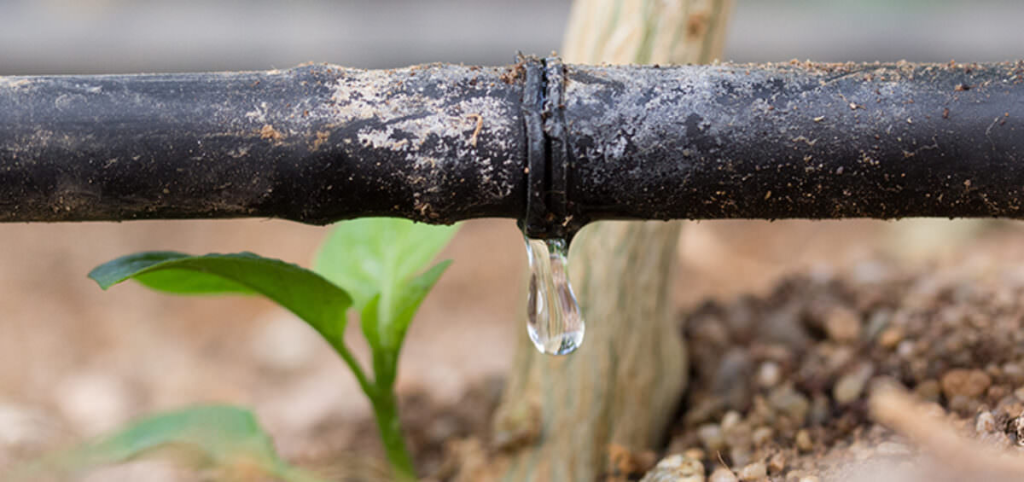
What Is Drip Irrigation in Kenya?
At its core, drip irrigation in Kenya is a micro-irrigation method that supplies water slowly and directly to the root zone of plants through a network of valves, pipes, tubing, and emitters. Instead of flooding an entire field, each plant receives calibrated droplets exactly where needed. The technology behind drip irrigation in Kenya has evolved dramatically over the past decade. Modern systems now incorporate pressure-compensating emitters, filtration units, and even solar-powered pumps tailored for Kenyan conditions. From arid northern counties to the highlands of Central Kenya, drip irrigation in Kenya adapts to diverse terrains and soil types.Farmers practicing drip irrigation in Kenya report fewer weed problems, reduced fertilizer leaching, and lower incidences of fungal diseases because foliage stays dry. These advantages make drip irrigation in Kenya particularly valuable for high-value horticultural crops.
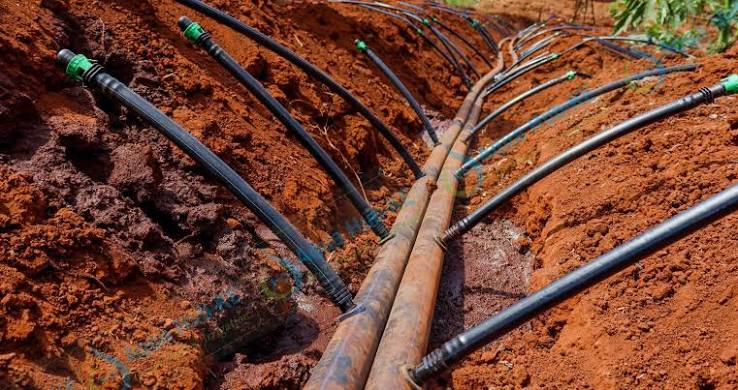
Benefits of Drip Irrigation in Kenya:
Understanding the advantages helps justify the initial investment. Here are the top reasons farmers choose drip irrigation in Kenya:
1. Water Conservation:
Kenya is a water-scarce country. Drip irrigation in Kenya uses 30–50% less water than sprinkler systems and up to 70% less than surface irrigation. Every drop counts when rivers run dry and borehole levels drop.
2. Increased Crop Yields:
Studies consistently show that farms using drip irrigation in Kenya achieve higher productivity. Onions, for instance, can yield 10–20 tons per acre under drip compared to 2-8 tons under rain-fed conditions.
3. Fertilizer Efficiency:
Through fertigation injecting soluble fertilizer into the drip lines farmers practicing drip irrigation in Kenya cut fertilizer costs by 25–30% while improving nutrient uptake.
4. Labor Savings:
Once installed, drip irrigation in Kenya reduces the labor previously spent hauling water and weeding. Automated timers and solar pumps further minimize manual intervention.
5. Year-Round Production:
The greatest economic advantage of drip irrigation in Kenya is the ability to farm during dry seasons when market prices peak. Off-season tomatoes, capsicum, Onions and French beans command premium prices in Nairobi supermarkets.
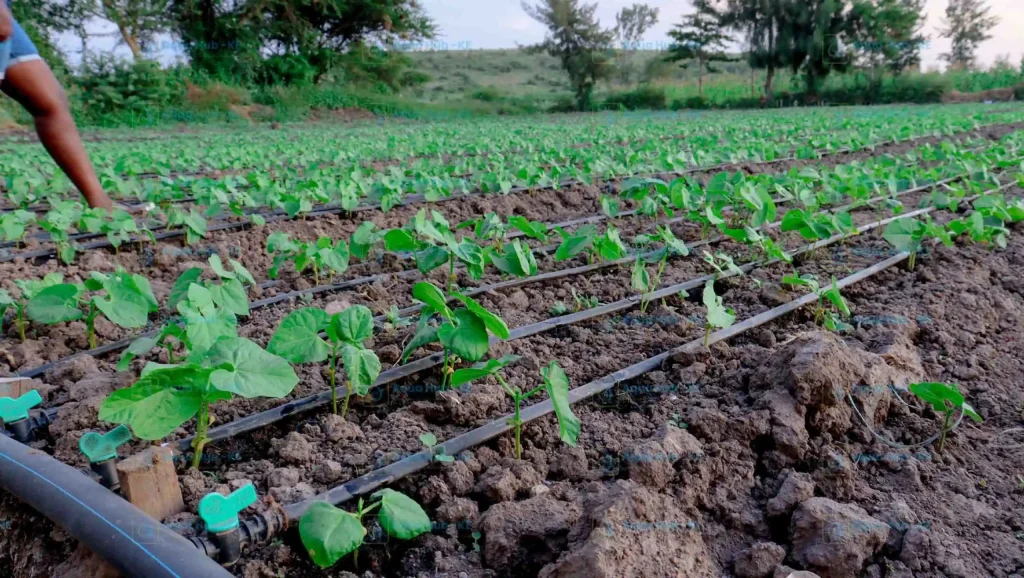
Best Crops for Drip Irrigation in Kenya:
While nearly any crop benefits, certain crops deliver exceptional returns under drip irrigation in Kenya:
| Crop | Why It Thrives Under Drip |
|---|---|
| Tomatoes | Prevents blossom-end rot through consistent moisture |
| Capsicum (Pili Pili Hoho) | Sensitive to water stress; drip ensures uniformity |
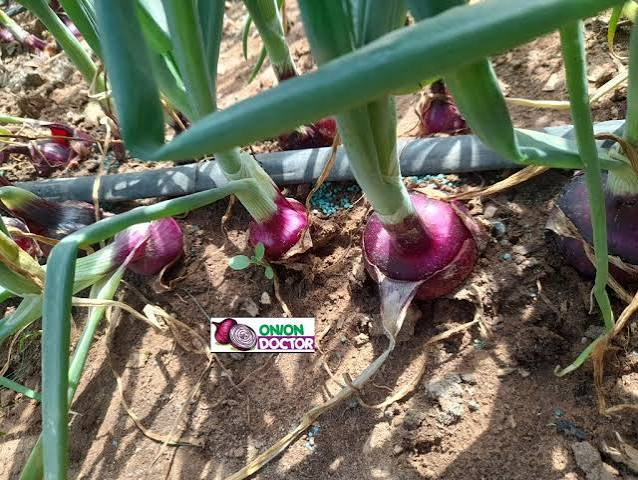
| Onions | Requires frequent light watering perfect for drip |
| French Beans | Export market demands quality only drip guarantees |
| Watermelons | Deep root penetration supported by precise scheduling |
| Passion Fruit | High-value crop needing controlled irrigation |
| Bananas | Large plantations benefit from fertigation via drip |
| Avocados | Young orchards establish faster with targeted watering |
Floriculture operations around Naivasha and Thika also rely heavily on drip irrigation in Kenya to maintain the exacting standards of European export markets.
Cost of Drip Irrigation in Kenya (2026):
Budgeting accurately prevents abandoned projects. The cost of drip irrigation in Kenya depends on acreage, water source, terrain, and crop type.
| Size/line per bed | 1 Line Per Bed | 2 lines Per Bed | 3 Lines Per Bed |
| 1 ACRE | KES 140,000 | KES 170,000 | KES 180,000 |
| 1/2 ACRE | KES 70,000 | KES 80,000 | KES 90,000 |
| 1/4 ACRE | KES 40,000 | KES 45,000 | KES 45,000 |
| 1/8 ACRE | KES 20,000 | KES 25,000 | KES 30,000 |
Pro Tip: Always request itemized quotations when purchasing drip irrigation in Kenya equipment. Compare emitter quality, pipe thickness, and warranty terms across suppliers.
Step-by-Step Installation of Drip Irrigation in Kenya:
While professional installers exist, understanding the process ensures you supervise effectively. Here is how drip irrigation in Kenya is typically installed:
Step 1: Water Source Assessment:
Identify whether you will use a borehole, river, water pan, or municipal supply. The source determines pump sizing and filtration requirements for your drip irrigation in Kenya system.
Step 2: Land Survey and Design:
Measure your field, noting elevation changes. Drip irrigation in Kenya designs must account for pressure variations; water flows downhill faster, requiring pressure regulators.
Step 3: Filtration System Installation:
Kenyan water sources often contain silt and organic matter. A sand media filter or disc filter is non-negotiable for protecting drip irrigation in Kenya emitters from clogging.
Step 4: Main and Sub-Main Laying:
Lay PVC or HDPE pipes from the water source across the farm. These form the backbone of your drip irrigation in Kenya network.
Step 5: Drip Line Placement:
Unroll drip tapes or lateral pipes along planting rows. Secure them with pegs, ensuring emitters face upward in surface drip irrigation in Kenya setups.
Step 6: Testing and Flushing:
Before planting, run water through the entire system. Flush all lines to remove debris. Proper flushing extends the lifespan of drip irrigation in Kenya equipment significantly.
Step 7: Scheduling and Maintenance:
Program irrigation intervals based on crop stage and weather. Regularly inspect filters, check emitter flow rates, and repair leaks promptly. Well-maintained drip irrigation in Kenya systems last 5–10 years.
Common Challenges and Solutions:
Even with excellent technology, drip irrigation in Kenya faces hurdles:
Emitter Clogging:
Solution: Install quality filters and flush lines monthly. Acid flushing once per season dissolves mineral buildup common in Kenyan borehole water.
High Initial Costs:
Solution: Start small. Many successful farmers began with a quarter-acre of drip irrigation in Kenya and reinvested profits to expand.
Lack of Technical Knowledge:
Solution: Attend training by Onion Doctor, county extension officers, or reputable irrigation companies. Knowledgeable operators achieve 40% better results from drip irrigation in Kenya than untrained ones.
Theft of Equipment:
Solution: Where security is a concern, bury main lines and remove portable components when not in use. Some farmers mark drip irrigation in Kenya pipes with indelible ink to deter resale.
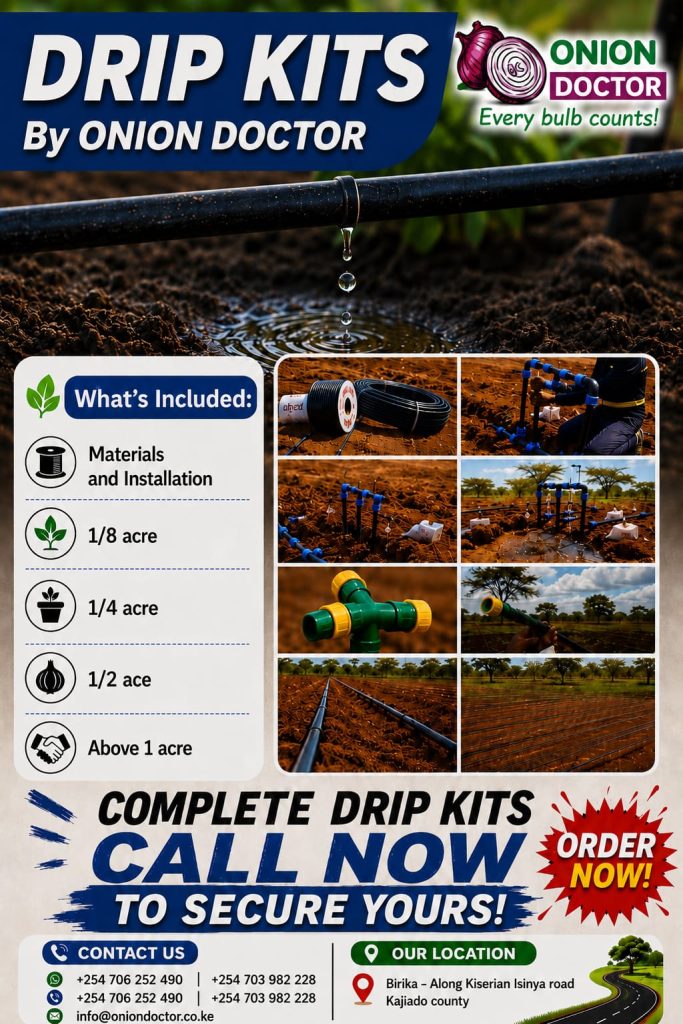
Are you in need of in-depth knowledge on onion and garlic production? If yes, we are a call away. Contact us for: Onion seedlings, Garlic seedlings, Germinated garlic cloves, Farm planning services, Soil testing, training on onion and garlic growing, Drip irrigation installation and maintenance, Agronomic support, Onion and Garlic value pack and Farm management. For free consultation, placing orders or booking a visit with an agronomist, please contact us via Call or what’s app +254703982228, Email: info@oniondoctor.co.ke You can also check out our social media handles for daily updates on TikTok: https://www.tiktok.com/@oniondoctorke0706252490?_r=1&_t=ZS-96UPUyx6ESL Instagram:https://www.instagram.com/oniondoctorke?igsh=MW5sZzJ6c3BnZ3Z0dw==Facebook:https://www.facebook.com/share/1HouRgLCwS/Twitter:https://x.com/OnionDoctorKe?s=20