
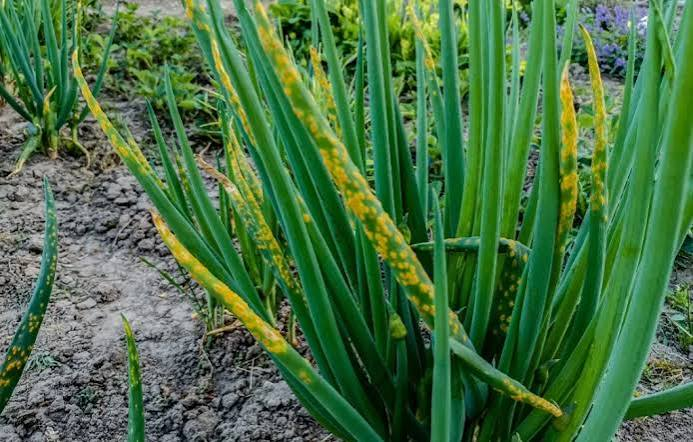
Picture this: You’ve invested KES 150,000 into your onion farming in Kenya operation. The seedlings from your nursery looked vibrant. The rains were generous. But one morning, walking through your field in Kajiado or Nyeri, you notice something terrifying bright orange pustules dotting your onion leaves like rust on old iron. Within weeks, your crop weakens, bulbs shrink, and your expected profit of over KES 500,000 evaporates. This is onion rust caused by the fungus Puccinia allii and it’s one of the most underestimated threats to onion farming in Kenya. While Kenyan farmers often worry about purple blotch, downy mildew, and thrips, rust quietly destroys yields from the inside out, reducing bulb size by up to 50% and making crops unmarketable.In this comprehensive guide, we’ll explore everything you need to know about onion rust: its biology, symptoms, lifecycle, and most importantly, how to prevent and manage it within the context of onion farming in Kenya. Whether you’re a smallholder in Kitui or a commercial grower in Nakuru, this guide will arm you with the knowledge to protect your investment.
Part 1: Understanding the Enemy:What is Onion Rust?
The Fungus Behind the Disease:
Onion rust is caused by Puccinia allii, a strictly parasitic fungus that belongs to the order Pucciniales the rust fungi. In onion farming in Kenya, understanding this pathogen’s biology is crucial because it determines when and how the disease strikes.The fungus is an obligate parasite, meaning it can only survive in the presence of living host plants. It attacks species within the genus Allium including onions, garlic, leeks, shallots, and chives.
Why Onion Rust Matters for Kenyan Farmers:
In the context of onion farming in Kenya, rust is particularly dangerous because:
- It spreads silently: Early symptoms are easy to miss
- It thrives in Kenyan highlands: The cool, wet conditions of Nyeri, Meru, and Mt. Elgon areas (15–24°C with high humidity) are ideal for infection
- It reduces marketability: Even a few lesions make spring onions unsalable, while bulb onions lose size and storage quality
- It persists in crop debris: The fungus overwinters in volunteer plants and wild Allium species
Once rust appears on a farm, continuous cropping of Allium species can lead to serious losses. This is a critical warning for onion farming in Kenya, where short rotations and continuous cropping are common practices.
Part 2: Recognizing the Symptoms Early Detection Saves Crops:
Early identification is critical in onion farming in Kenya because once rust is established, chemical control becomes necessary, and prevention is always cheaper than cure.
Initial Symptoms (Week 1–2):
- Small, light yellow to white flecks on older leaves
- These flecks are slightly raised and may be mistaken for dust or spray residue
- Often appear first on lower, older leaves before spreading upward
Active Infection (Week 2–4):
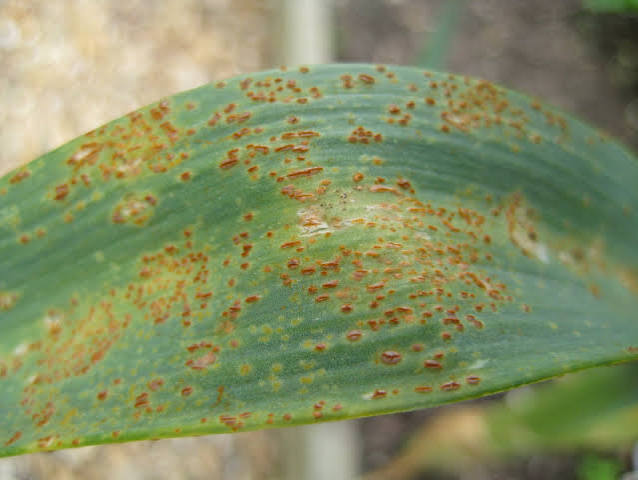
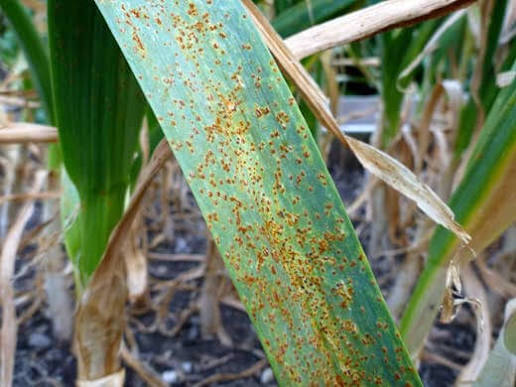
- Flecks expand into oval to diamond-shaped pustules
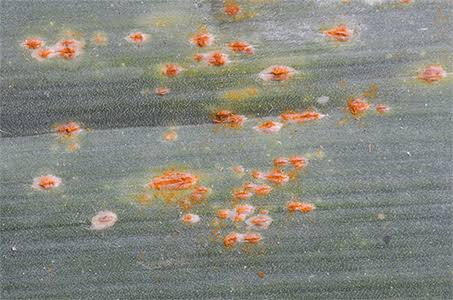
- Pustules turn bright orange to reddish-orange as spores mature
- The surface breaks open, releasing powdery, dusty spores
- Severely affected leaves become completely covered with pustules
Advanced Damage (Week 4+)
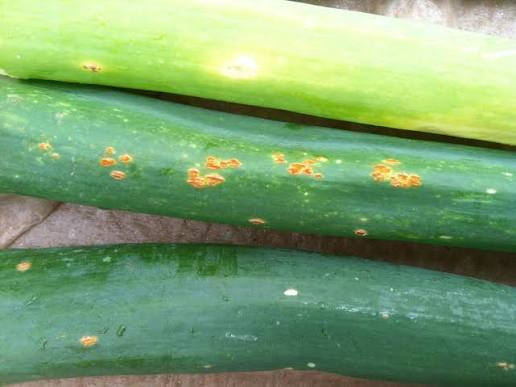
- Leaves turn chlorotic (yellow) due to reduced photosynthesis
- Foliage wilts, shrivels, and dies prematurely
- Black teliospores appear within darkened pustules
- Bulb impact: Reduced size, poor protective coats, deformations, and increased sensitivity to handling and storage rot
Even a few lesions can reduce marketability in crops like spring onions where the leaves are eaten. For bulb production in onion farming in Kenya, the impact is equally severe—smaller bulbs mean lower prices per kilogram
Part 3: Conditions That Favor Onion Rust in Kenya:
The Perfect Storm: Climate and Cultural Factors:
For onion farming in Kenya, several conditions create ideal environments for rust:
1. Temperature Sweet Spot The fungus thrives between 15°C and 24°C. This means:
- Highland areas (Nyeri, Meru, Mt. Elgon, parts of Nakuru): High risk during rainy seasons
- Mid-altitude zones (Kirinyaga, Embu, Murang’a): Moderate risk year-round
- Dry lowlands (Kajiado, Narok, Kitui): Lower risk but outbreaks occur during unusual cool, wet spells
2. Humidity and Leaf Wetness:
- 100% relative humidity for 4+ hours triggers infection
- Overhead irrigation, heavy dew, and poorly ventilated fields increase risk
- Dense planting (poor spacing) raises humidity within the canopy
3. Nutritional Imbalances: Infection is worse on nitrogen-rich soils with low potassium. In onion farming in Kenya, where farmers often over-apply nitrogen to boost growth, this creates a hidden vulnerability.
4. Continuous Cropping Growing onions, garlic, or leeks in the same field year after year builds up inoculum. The fungus overwinters in debris and volunteer plants, making the next season’s crop more vulnerable.
5. Weedy Allium Hosts Wild onion relatives and uncontrolled volunteer plants serve as reservoirs for the fungus, constantly reinfecting commercial fields.
Part 4: Integrated Management Strategies for Onion Farming in Kenya:
Effective rust management in onion farming in Kenya requires an integrated approach combining cultural, biological, and chemical methods. No single strategy is sufficient.
Strategy 1: Cultural Control (The Foundation):
Crop Rotation
- Rotate out of Allium crops for 2 to 3 years
- Plant non-host crops: maize, beans, cowpeas, or root vegetables
- This is particularly important in onion farming in Kenya, where small plots often force continuous cropping
Sanitation
- Remove and destroy all crop residues after harvest don’t compost infected material
- Eliminate volunteer onions and garlic from previous crops
- Control wild Allium weeds in and around fields
- In onion farming in Kenya, where labor is available, this is a cost-effective first line of defense
Proper Spacing and Ventilation:
- Maintain 30 cm between rows and 8–10 cm between plants
- Avoid overcrowding, which traps moisture and raises humidity
- Plant in fields with good air movement; align rows with prevailing winds
Irrigation Management:
- Avoid overhead irrigation when possible use drip irrigation instead
- If sprinklers are necessary, water early in the morning so leaves dry quickly
- Don’t irrigate within 10–14 days of harvest
- In onion farming in Kenya, drip irrigation is becoming more accessible and should be prioritized.
Balanced Fertilization:
- Avoid excessive nitrogen, especially late in the season.
- Ensure adequate potassium levels soil testing is essential.
- Split nitrogen applications rather than single heavy doses.
Resistant Varieties While no fully resistant onion varieties exist, some show partial tolerance. In onion farming in Kenya, consider:
- Red Creole: Drought-tolerant with some field resilience
- Hybrid varieties (Red CoachF1, Neptune F1): Often bred for better disease resistance
- Texas Grano: While not rust-specific, its vigor helps it recover
Strategy 3: Chemical Control (The Last Resort):
When rust appears, fungicides may be necessary. For onion farming in Kenya, the following approaches are used:
Protectant Fungicides
- Mancozeb : Multi-site contact fungicide; apply before infection
- Copper sulfate: Organic option; less effective but acceptable
Critical Application Rules for Onion Farming in Kenya:
- Start early: Begin applications at first sign of disease or when conditions favor infection
- Rotate modes of action: Never use the same fungicide class twice in a row to prevent resistance
- Ensure coverage: Thorough foliar coverage is essential rust infects leaves, not bulbs
- Follow PHI: Respect pre-harvest intervals (typically 7–14 days)
- Scout regularly: Inspect fields every 3–5 days during high-risk periods
Strategy 4: Onion Doctor App:
Scan your onion plant using the Onion Doctor app to identify the disease correctly and get help from our Agronomist.
Climate-Smart Practices for Onion Farming in Kenya:
To reduce rust and other disease pressures:
- Match variety to climate: Don’t plant highland varieties in hot dry zones, or vice versa
- Use certified seeds: Avoid recycled seeds that may carry pathogens
- Plan for irrigation: Drip systems reduce leaf wetness and rust risk
- Soil preparation: Raised beds in well-drained sandy loam (pH 6.0–6.8)
- Proper curing: Dry bulbs thoroughly before storage to prevent secondary infections
- Crop rotation: Never plant onions on the same land twice in a row
Are you in need of in-depth knowledge on onion and garlic production? If yes, we are a call away. Contact us for: Onion seedlings, Garlic seedlings, Germinated garlic cloves, Farm planning services, Soil testing, training on onion and garlic growing, Drip irrigation installation and maintenance, Agronomic support, Onion and Garlic value pack and Farm management. For free consultation, placing orders or booking a visit with an agronomist, please contact us via Call or what’s app +254703982228, Email: info@oniondoctor.co.ke You can also check out our social media handles for daily updates on TikTok: https://www.tiktok.com/@oniondoctorke0706252490?_r=1&_t=ZS-96UPUyx6ESL Instagram:https://www.instagram.com/oniondoctorke?igsh=MW5sZzJ6c3BnZ3Z0dw==Facebook:https://www.facebook.com/share/1HouRgLCwS/Twitter:https://x.com/OnionDoctorKe?s=20